

United Stainless LLP is a leading Stainless steel plates form a keystone of modern industry, with the advantages of strength, durability and a resistance to corrosion. Heavy engineering and construction as well as automotive and energy industries are some of the areas where these flat-rolled materials are used to offer structural stability, durability, and flexibility. It is important to understand their different grades and their different applications in practice to ensure that engineers, procurement teams and industrial people understand how to align material performance to the needs of the project.
The unique characteristic of stainless steel is its content of chromium that forms a protective oxide on the surface. This coating helps to avoid rust, as well as increase the life of the metal, and it enables the steel to work in a reliable manner even in severe or corrosive conditions. Stainless steel plates may be available with specialized properties including high-temperature resistance, wear resistance or improved mechanical strength depending on the alloy composition.
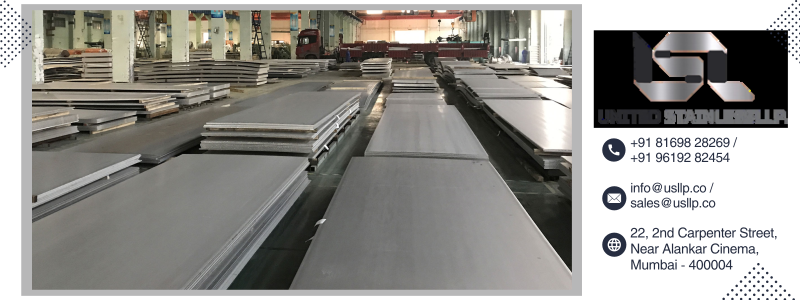
What Are Stainless Steel Plates?
Stainless steel plates are flat, rectangular metallic products, which are conventionally more than 3 mm in thickness. They are produced either by hot or cold rolling and are chosen when dimensional stability, strength and load-bearing capacity is a requirement. Plates have the ability to carry heavier structural loads compared to sheets hence can be used in the base of machinery, storage tanks, cladding, bridges and industrial equipment.
The automotive, chemical, power and construction industries are the ones that are dependent on stainless steel plates to offer the durability and beauty demanded in tough applications. By selecting a reputable Stainless Steel Plate Manufacturer in India, the materials used will be of industrial quality and will be reliable in severe projects.
Advantages of Stainless Steel Plates
The widespread use of stainless steel plates is due to several key advantages:
- Corrosion Resistance: Chromium in stainless steel creates a passive oxide layer to prevent rusts and has a longer life of the components even in the outside or a humid environment.
- Strength and Durability: Stainless steel plates offer great mechanical strength, which makes them stable in a structural, automotive or machinery application.
- Adaptability: Stainless steel plates are available in a variety of grades, and can be designed to meet specific requirements, such as heat-resistant substances or wear-resistant surfaces.
- Welding, cutting and forming: These plates are easy to weld, cut and shape so that manufacturing is less complicated.Maintenance: They are resistant to corrosion and are durable; hence, minimal maintenance requirements (Limited lifetime cost).
The cooperation with the Stainless Steel Plate Supplier that operates in India provides the industries with the reliable access to the quality and the timely delivery, which is extremely important in the large-scale projects and the industrial fabrication.
Key Stainless Steel Plate Grades and Their Uses
Selecting the appropriate grade is critical for ensuring the plate performs reliably in its intended application. Below are some commonly used grades and their practical uses:
Stainless Steel 3CR12 Plates
The 3CR12 plates are low-carbon steel plates that contain a lot of chromium and serve as a low-cost alternative to the standard stainless steels. They have moderate corrosion resistance, good weldability and fabrication is easy. The plates are mostly employed in mining equipment, material handling applications, and structural applications which do not necessitate full austenitic stainless steel.
Stainless Steel X2CRNi12 Plates
The X2CRNi12 is a ferritic stainless steel that has chromium and traces of nickel. It has an excellent corrosion resistance as compared to plain carbon steels and good mechanical strength. It is common in automobile exhaust systems, enclosures in industries, and in parts that are exposed to moderately hot and humid environments. The low amount of carbon minimizes the chances of intergranular corrosion.
Stainless Steel 409Ms Plates
The 409Ms plates are stabilized ferritic stainless steel plates that are highly resistant to high temperatures oxidation. They are usually utilized in exhaust systems, heat shields, and thermal equipment. It is popular in industrial fabrication projects and the Ms variety is readily available and provides value balance between performance and cost.
Stainless Steel 409 / 409L Plates
The 409 and 409L grades are ferritic stainless steel plates which are also characterized by resistance to high temperatures oxidation. The low-carbon type 409L has better weldability as well as less carbide precipitation. These plates find wide range of application in auto exhaust parts, mufflers, shells of catalytic converters, and even heat exchanger in industries. They are cheap hence preferred in large scale production.
Stainless Steel 410 Plates
The martensitic stainless steel family consists of 410 plates which are known to be strong and hard. They may also be heat-treated to obtain greater mechanical strengths and hence suit turbine parts, valve parts, cutlery and wear resistant industrial equipment. Although their corrosion resistance is not as good as ferritic or austenitic grades, they are reliable in dry or slightly corrosive conditions. By getting a reliable supplier of Stainless Steel Plate, the consistency of quality of such high-performance grades can be assured.
Practical Applications Across Industries
Stainless steel plates find applications in a wide range of sectors:
- Construction and Infrastructure: Bridges, building frames, architectural surface, and industrial structures that include strength and corrosion-resistance are constructed on plates.
- Automotive Industry: 409Ms and 409L are some of the grades suitable in exhaust systems, mufflers and heat resistant parts.
- Manufacturing and Engineering: Plates are used as foundations to machinery, fabrication to tanks and pressure vessels and elements that need to withstand mechanical forces.
- Energy and Power Plants: Boilers, heat exchangers, and turbines enjoy the plates that are not affected by high temperatures and scaling.
- Mining and Material handlers: 3CR12 plates are cost effective in terms of durability of conveyors, chutes, and industrial equipment that are in operation in order to face wear and moderate corrosion.
Maintenance and Longevity of Stainless Steel Plates
The stainless steel plates have attracted a low-maintenance character that contributes to their adoption in most industries. The chromium content forms natural oxide film that prevents corrosion thus eliminating the frequency of protective coating. However, frequent washing may be a solution to preserve their appearance and operation in the very contaminated or damp conditions.
Plates made of stainless steel are commonly applied in highly wear or highly hot industries, e.g. exhaust, chemical tanks, and heat exchangers. They last long even under such harsh conditions and this guarantees them less downtime and reduced replacements. Proper welding and penetrating can be done such as smooth welds and the correct usage of fasteners and also not to create surface scratches which can prolong the service life of the plates.
Additionally, stainless steel plates can be recycled without compromising on their properties and therefore are cost-effective and environmentally sustainable option to industries that are dedicated to the implementation of the circular economy. Their capacity to maintain their strength, their resistance to oxidation and their ability to withstand thermal stress is the reason why the industrial projects are structurally sound over decades.
Conclusion
The stainless steel plates cannot be done away with in the contemporary industry as they provide the strength, resistance to corrosion and a wide range of applications. Industries are offered the option of materials in different performance requirements with grades of 3CR12, X2CRNi12, 409Ms, 409 / 409L, and 410. Stainless steel plates are a strategic investment in manufacturing, construction, automobile, and energy because of their long-term life and low maintenance needs and the ability to operate in harsh conditions. Knowing the characteristics and the applications of each grade, engineers and industrial consumers will be able to make their projects successful and at the same time achieve the maximum efficiency and cost-effectiveness.
Frequently Asked Questions
Stainless steel plates are widely used in construction, automotive, manufacturing, energy, and engineering industries. They are used for structural components, exhaust systems, storage tanks, machinery bases, heat exchangers, and industrial fabrication where strength, corrosion resistance, and durability are required.
The main difference lies in thickness and application. Stainless steel plates are thicker and designed for load-bearing and structural applications, while sheets are thinner and typically used for cladding, decorative purposes, or lightweight fabrication. Plates provide higher strength and better resistance to deformation under stress.
Stainless steel plates are generally easy to weld and fabricate, especially ferritic and low-carbon grades. Proper welding techniques, suitable filler materials, and controlled heat input help maintain mechanical strength and corrosion resistance during fabrication.