

United Stainless LLP is also engaged in the activity of providing stainless steel round bars to meet the diverse industrial uses. Stainless steel round bars are used as one of the long products in the manufacturing industry, fabrication and heavy engineering projects. Weight calculation is one of the most significant technical factors which go hand in hand with these bars as it directly influences the cost of material, transportation organization and the performance of the structures.
Learning about the stainless steel round bar weights is not only a technical need, but also a practical need among the engineers, buyers and the project managers.
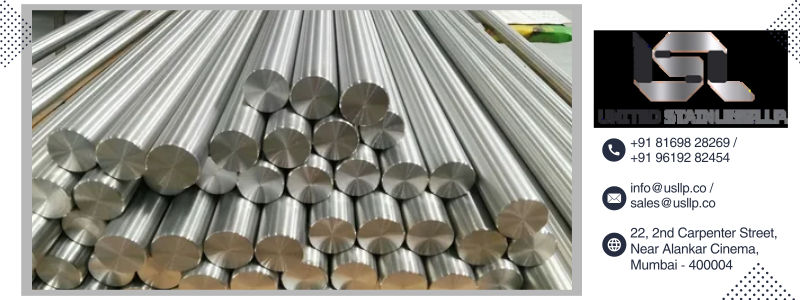
What Are Stainless Steel Round Bars?
In stainless steel, round bars are the solid metal products produced by any of the processes of hot rolling, cold drawing, or forging. They occur in different types of stainless steel including 304, 304L, 316, 316L, 321, 310 and martensitic grades depending on the requirements of the application.
Such round bars are commonly used in:
- Shafts and spindles
- Components and fasteners that are machined.
- Structural frameworks
- Sea and offshore machinery.
- Chemical processing industries, oil and gas.
Other than grade selection, diameter and weight are also important in dictating the suitability to a particular application.
Why Stainless Steel Round Bar Weight Matters
In practice in the industry, stainless steel round bars are being sold and bought in weight rather than length. When there is a wrong estimation of weight, then it may cause a number of problems including:
- Mistakes in quotes and invoice
- High cost of transportation and handling.
- Wrong budgeting in the project.
- Ineffective inventory/stock planning.
That is why the correct calculation of the weight is necessary before any order is made or fabrication work commenced.
Standard Formula for Weight Calculation
The weight of a stainless steel round bar is calculated using a globally accepted formula:
Weight (kg) = (Diameter² × Length × Density) ÷ 162
Where:
- Diameter is measured in
millimeters (mm)
- Length is measured in
meters (m)
- Density of stainless steel
is approximately 7.93 g/cm³
This formula forms the foundation of all standard stainless steel round bar weight charts used in the industry.
Understanding Dimensions and Their Impact on Weight
Stainless steel round bars are available in diameters starting from as small as 6 mm and extending up to 300 mm or more. Standard lengths generally include 3 meters, 6 meters, and custom cut lengths.
An important point to understand is that weight increases with the square of the diameter. For example:
- A 20 mm round bar does not
weigh double of a 10 mm bar
- Instead, it weighs nearly
four times more
This relationship makes it essential to refer to weight charts, especially when working with larger diameters.
Stainless Steel Round Bar Weight Chart
|
Size (mm) |
Round (Kg/mtr) |
Hex (Kg/mtr) |
Square (Kg/mtr) |
|
2 |
0.025 |
0.027 |
0.031 |
|
3 |
0.056 |
0.061 |
0.070 |
|
4 |
0.100 |
0.108 |
0.125 |
|
5 |
0.156 |
0.172 |
0.197 |
|
6 |
0.224 |
0.248 |
0.283 |
|
7 |
0.305 |
0.333 |
0.385 |
|
8 |
0.399 |
0.441 |
0.504 |
|
9 |
0.505 |
0.550 |
0.637 |
|
10 |
0.623 |
0.689 |
0.787 |
|
11 |
0.754 |
0.822 |
0.952 |
|
12 |
0.897 |
0.992 |
1.134 |
|
13 |
1.053 |
1.148 |
1.330 |
|
14 |
1.221 |
1.350 |
1.543 |
|
15 |
1.402 |
1.550 |
1.771 |
|
16 |
1.595 |
1.763 |
2.015 |
|
17 |
1.801 |
1.991 |
2.275 |
|
18 |
2.019 |
2.232 |
2.551 |
|
19 |
2.250 |
2.487 |
2.842 |
|
20 |
2.493 |
2.755 |
3.149 |
|
21 |
2.748 |
3.038 |
3.472 |
|
22 |
3.016 |
3.331 |
3.810 |
|
23 |
3.297 |
3.507 |
4.164 |
|
24 |
3.590 |
3.967 |
4.534 |
|
25 |
3.895 |
4.305 |
4.920 |
|
26 |
4.213 |
4.594 |
5.321 |
|
27 |
4.543 |
5.021 |
5.739 |
|
28 |
4.886 |
5.400 |
6.172 |
|
30 |
5.609 |
6.199 |
7.085 |
|
32 |
6.382 |
7.053 |
8.061 |
|
Size (mm) |
Round (Kg/mtr) |
Hex (Kg/mtr) |
Square (Kg/mtr) |
|
34 |
7.204 |
7.963 |
9.100 |
|
35 |
7.634 |
8.438 |
9.643 |
|
36 |
8.077 |
8.927 |
10.202 |
|
38 |
8.999 |
9.946 |
11.367 |
|
40 |
9.971 |
11.021 |
12.595 |
|
42 |
10.990 |
12.150 |
13.886 |
|
45 |
12.620 |
13.948 |
15.941 |
|
50 |
15.580 |
17.220 |
19.680 |
|
55 |
18.852 |
– |
– |
|
58 |
20.964 |
– |
– |
|
60 |
22.435 |
– |
– |
|
65 |
26.330 |
– |
– |
|
70 |
30.573 |
– |
– |
|
75 |
35.055 |
– |
– |
|
80 |
39.885 |
– |
– |
|
85 |
45.026 |
– |
– |
|
90 |
50.479 |
– |
– |
|
95 |
56.224 |
– |
– |
|
100 |
62.320 |
– |
– |
|
105 |
68.708 |
– |
– |
|
110 |
75.407 |
– |
– |
|
115 |
82.418 |
– |
– |
|
120 |
89.741 |
– |
– |
|
125 |
97.375 |
– |
– |
|
130 |
105.321 |
– |
– |
|
135 |
113.578 |
– |
– |
|
140 |
122.147 |
– |
– |
|
145 |
131.028 |
– |
– |
|
150 |
140.220 |
– |
– |
Role of Weight Charts in Industrial Planning
A Stainless Steel round bar weight chart offers prepared weight values per meter of varying diameters. These charts remove the use of repetitive manual calculations as well as saving time by professionals.
The majority of the consumers and engineers target at Stainless steel Round Bar Weight Chart in kg because the unit of kilogram is the most common metric used in pricing, logistics and accounting of the material.
Test-takers of weight charts are:
- Purchase and procurement departments.
- Fabrication and machining departments.
- Project managers and site engineers.
- Warehouse departments and logistics.
Benefits of PDF Weight Charts
With increasing digital usage, many professionals prefer Stainless steel Round Bar Weight Chart in pdf format. PDF charts offer several practical advantages:
- Easy offline
access
- Convenient printing for
shop-floor use
- Simple sharing across
teams and project sites
PDF weight charts are especially useful for on-site engineers who need quick references without relying on online tools.
Factors That Can Affect Actual Weight
Although weight charts provide standard values, actual bar weight may vary slightly due to:
- Manufacturing
tolerances
- Minor diameter
deviations
- Surface finish (black bar,
bright bar, polished bar)
- Cut length
accuracy
For applications where precision is critical, actual weighment is recommended. However, for estimation and planning, standard charts remain highly reliable.
Applications Where Accurate Weight Is Critical
Accurate stainless steel round bar weight calculation is crucial in applications such as:
- Rotating shafts and
mechanical components
- Load-bearing structural
parts
- Marine and offshore
equipment
- Heavy machinery and
pressure vessels
In these applications, weight directly impacts performance, safety, and operational efficiency.
Conclusion
Understanding stainless steel round bar weights is essential for accurate material planning, cost control, and smooth project execution. By knowing the correct dimensions, applying the standard formula, and using reliable weight charts, professionals can avoid errors and make informed decisions.